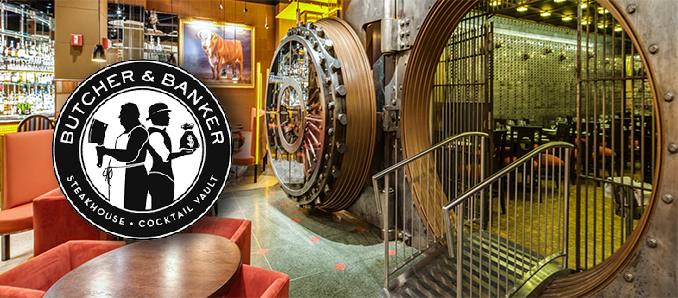
 The former bank vault beneath New York City’s historic New Yorker Hotel had sat vacant for more than 30 years when the hotel offered it to restaurateur Alex Sgourdos, owner of the Tick Tock Diner on the busy corner above. Sgourdos knew the space had potential, but what to do with a space that had never been a restaurant and was hidden out of sight beneath a hotel? He decided to hire world-renowned restaurant consultant Michael Whiteman, who heads Baum+Whiteman International Restaurant Consultants (best known for projects like Windows on the World and the Rainbow Room in NYC) to conceive a project that nodded to the hotel’s Art Deco past while appealing to modern diners – Butcher & Banker, NYC’s first “steak-easy.”
 The New Yorker Hotel opened in 1930 at the height of the Great Depression as the then largest hotel in New York City. For years, it attracted a who’s who of entertainers and dignitaries from around the world, from Muhammad Ali to JFK to Joan Crawford to Nikola Tesla, who spent his final years in the hotel. The existence of the bank vault below the hotel dates back to how the building was constructed. The Manufacturers Trust Company owned a building on a corner of 34th Street and in exchange for tearing it down, the bank gained a free 50 year lease on office space and a vault in the hotel. After the bank closed in 1980, the vault was used for storage.
Whiteman enlisted architect Richard Bloch to make the space functional and inviting. Bloch has designed hundreds of projects around the world, including Masa, Shuko, the Empire Steakhouse and more in NYC. “We were particularly careful not to build a “bank-themed restaurant,” Whiteman says. “Instead, we focused on a slightly Jazz Age, slightly Mad Men ambience with overtones of a speakeasy, pulling inspiration from old school New York. It’s reminiscent of a place where one would have a cigar and strong drink over dinner, a place where you’d have no qualms about cuddling up to your significant other in one of the capacious booths. Even down to our playlist, we wanted to recreate that era with up-tempo jazz standards from the ’30s, ’40s and ’50s.”